FA2 Fellowship| Session 1 : Intro to Blockchain
The shift from simple digital files to blockchain-based artworks changes how digital art and culture are made and understood. Instead of just using a blockchain for minting NFTs, artists can also use it as an immaterial, time-based medium that can host autonomous art networks and more.
The Tezos Foundation and the Museum of the Moving Image have launched the FA2 Fellowship as part of their 2025-2026 Partnership, with the aim of empowering artists and builders to learn from industry experts about the Tezos blockchain smart contract applications and develop their own projects.
The Fellowship started with a session led by Beata Lipska, DevRel Lead at Trilitech, explaining the basics of the Tezos blockchain, covering what role smart contracts and tokens play in artistic production, and how the FA2 Standard acts as a common language for art tokens on Tezos. With blockchain, artists don’t just create static objects; they can design systems of behaviour executed by the self-governing logic of the smart contract.

Kyle Flemmer, Microcosmos (2023), on-chain pixel art with custom smart contract on Tezos
1.From Digital Files to On-Chain Artworks
Historically, digital art existed as isolated files, such as JPEGs or MP4s, that were infinitely reproducible and impossible to control once released online. The Tezos blockchain does not alter the inherent reproducibility of these files; instead, it introduces a new, structured framework for representing and circulating digital works. An artwork on Tezos can be defined by three main components:
1. The File on Tezos
The initial state of digital art, a simple digital file (JPEG, MP4, MP3 etc.) that is often the first point for a collector to derive meaning from. However, this file is infinitely reproducible and has to be linked to a specific token on the Tezos blockchain to be able to leverage on-chain mechanics and unlock the collectibility of a digital artwork. Typically, artwork files are normally stored on IPFS or Arweave, not directly on the blockchain, although it is also possible to store smaller files on-chain.
2. Token
A token on the Tezos blockchain is a unique, verifiable record that stores ownership history and essential metadata, establishing its distinct identity within the network. The creation of metadata is part of the on-chain artistic practice: an on-chain artwork relies on the metadata that defines how it is recognized, referenced, and differentiated from all other tokens. Collectors seek uniqueness, not indistinguishable copies, and on-chain uniqueness is expressed through this metadata layer. Each token is further shaped by the smart contract that governs it, which specifies the rules and behaviours that determine how the token functions.
3. Smart Contract
A smart contract typically defines the basic rules that govern how an asset can be used; transferred, traded, or interacted with. For on-chain artistic practice, however, this should be only the starting point. The smart contract is a narrative engine, and developing its own unique logic becomes a way to expand the storytelling potential of an artwork. Here, the art is not merely accompanied by code; the art is the code, continuously running, reacting, and evolving within the blockchain environment.
Artists can design behaviours such as burning and merging tokens, or creating dynamic relationships between tokens, metadata, and visuals. The blockchain functions as a programmable canvas, and its full expressive potential emerges when artists treat smart contract logic as an integral part of the artistic medium.
2. Blockchain Fundamentals
The Tezos blockchain functions as a decentralised, public ledger composed of cryptographically linked blocks, forming a verifiable chronological sequence. This structure ensures immutability; once recorded, data cannot be altered.
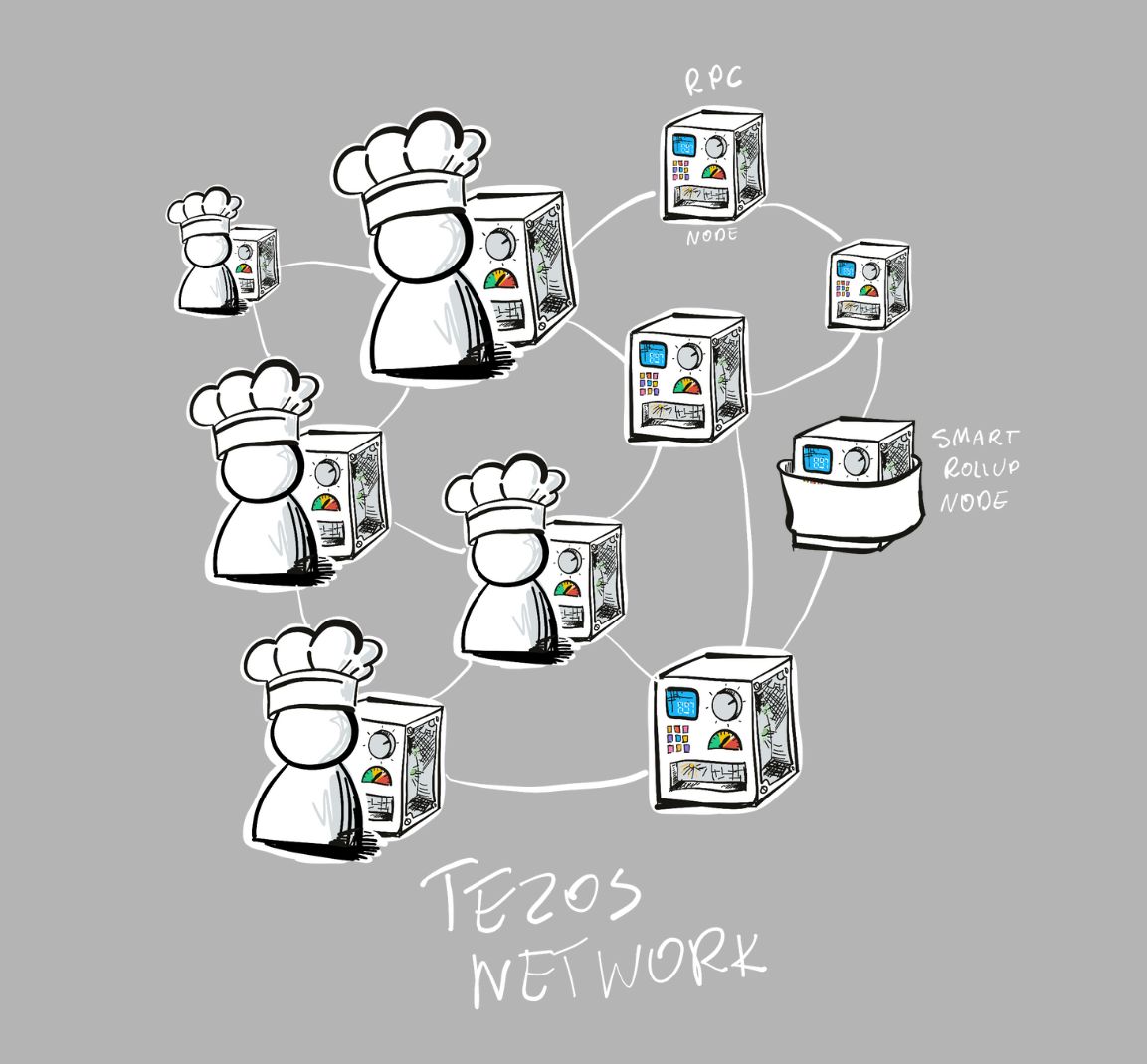
Tezos uses a variation on Proof-of-Stake (PoS) consensus mechanism, which governs how the network reaches agreement and records its history. This mechanism ensures that every update to the chain is validated, ordered, and permanently anchored in time.
Blocks: The result of this process is a continuous sequence of blocks. Each block is a timestamped unit that contains validated transactions and smart contract operations. Because every block is cryptographically linked to the one before it, the chain forms an irreversible timeline, where the integrity of an artwork’s history remains fixed and verifiable.
Nodes (The Network): The physical infrastructure of Tezos consists of nodes, individual computers connected in a global peer-to-peer web. Nodes act as the custodians of the ledger; they store the blockchain's full history or partial history (depending on the node type) and propagate transactions across the network. Crucially, nodes enforce the protocol's rules by verifying every transaction they receive, ensuring that invalid data is rejected before it ever reaches a block.
Bakers (Validators): While nodes maintain the ledger, bakers write the new entries. By staking XTZ (the native token) as collateral, bakers commit to producing and validating blocks honestly. Their work ensures the security of the chain: each block they create advances the timeline and maintains the chronological order that all token-based activity depends on.

3. Smart Contracts and FA2 Fundamentals
On blockchains, smart contracts define how on-chain assets behave. Once deployed, they become immutable, autonomous programs that hold both the logic and the storage, shaping a token’s state over time. They can also incorporate oracles to bring external data into the otherwise closed blockchain environment. In this way, smart contracts form the foundational ruleset for building systems of tokens.
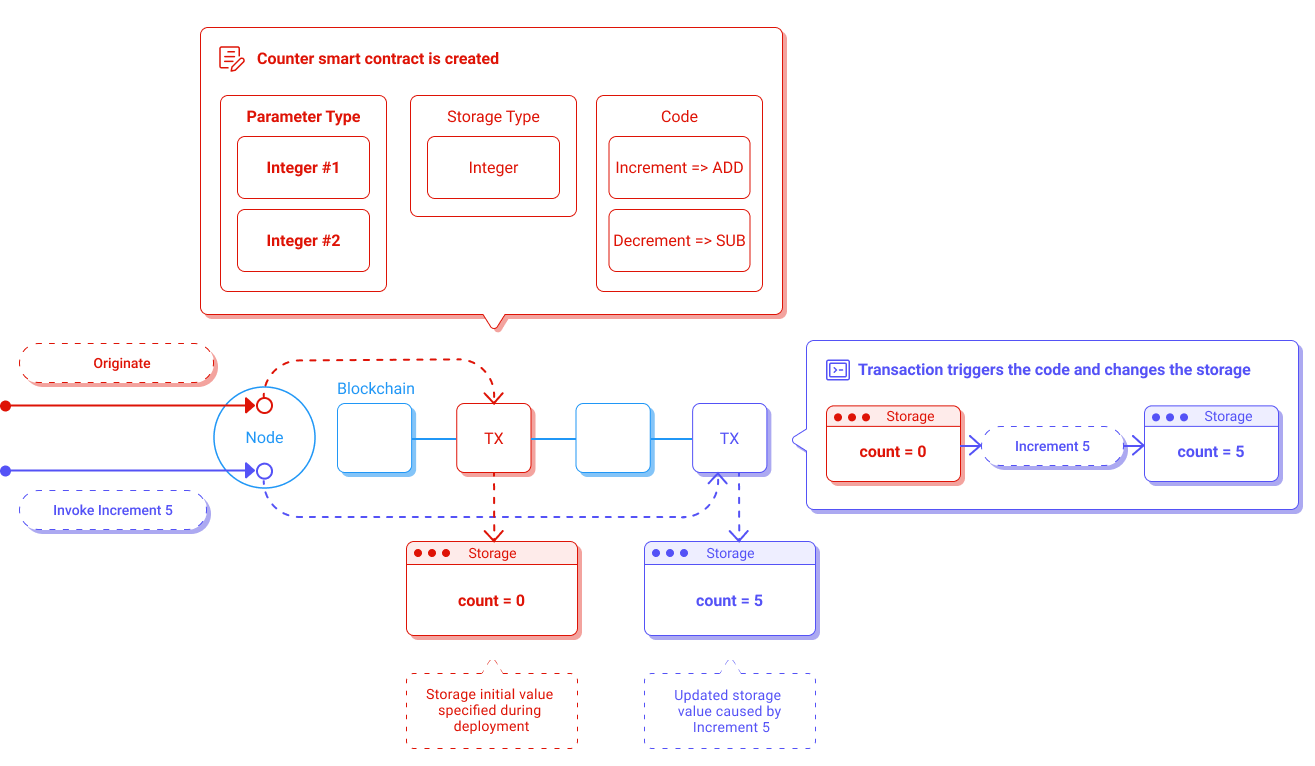
Call of a smart contract triggering its code and modifying its storage's state
The FA2 extends the foundational ruleset by providing a unified framework for creating and managing tokens on Tezos. By defining a common set of entry points to standardise smart contract operations, FA2 ensures seamless interoperability across wallets, marketplaces, and galleries, empowering creators to design increasingly sophisticated mechanisms while maintaining full compatibility throughout the ecosystem.
4. Creative Applications of Tezos Blockchain
While FA2 provides the standard structure, the creative application is limitless. Blockchain is not just a ledger; it is a programmable environment where artists can construct complex narratives using code.
To outline the creative possibilities, these are key conceptual approaches artists can draw on, though they should not feel limited to them:
Generative Minting: The act of minting itself creates the art. Each token becomes a unique variation, determined by on-chain randomness or transaction parameters at the moment of creation.
Dynamic Evolution: The artwork is alive. It can change its visual state based on on-chain events. For example, a flower that blooms only when the artist's wallet balance increases, or a portrait that ages with every block.
Time-Based State Change: Works that age, decay, unlock, or transform as time progresses.
Interaction & Breeding: Tokens can influence one another. Imagine creating two token types: Seed and Soil. If a collector holds both, the smart contract allows them to merge into one new token, burning the two original tokens to create Sprout. A new token inheriting traits from its both parent tokens.
Community Governance: Ownership can become an active component of an artwork, rather than a passive state. A smart contract can grant collectors voting rights to decide the artwork's future, such as selecting the next colour palette or unlocking a new chapter of the project.
5. Next steps
Before deploying your own contract, familiarity with these tools will help you navigate the Tezos ecosystem and maybe find inspiration in already existing projects on Tezos:
Wallets (Temple, Kukai, Umami): User interfaces for interacting with the Tezos blockchain.
Block Explorers (TzKT): Platforms for inspecting on-chain activity, transactions, and contract states.
SmartPy: A high-level language for writing custom smart contracts that compile to Michelson. This will be covered in the FA2 Fellowship Session 2.
Taquito: A TypeScript library that lets websites communicate with smart contracts, enabling interactive on-chain experiences.
Ghostnet: A public test network where contracts can be deployed and experimented with at no cost.
Ultimately, blockchain is freedom of expression. Therefore, approach this novel infrastructure not as a technical hurdle, but as a powerful global medium with no geographical boundaries. Embrace it to amplify your voice, secure your on-chain presence, and push the boundaries of what your art can become.
To learn more about exploring blockchain as a medium, sign up to future sessions of the MoMI x Tezos FA2 Fellowship